Period: April 26-May 5, 2026
Source note: I filtered my X bookmarks by tweet
postedAtdate. The bookmarks API gives the tweet date, not the exact date I bookmarked it, which is an annoying but useful distinction.
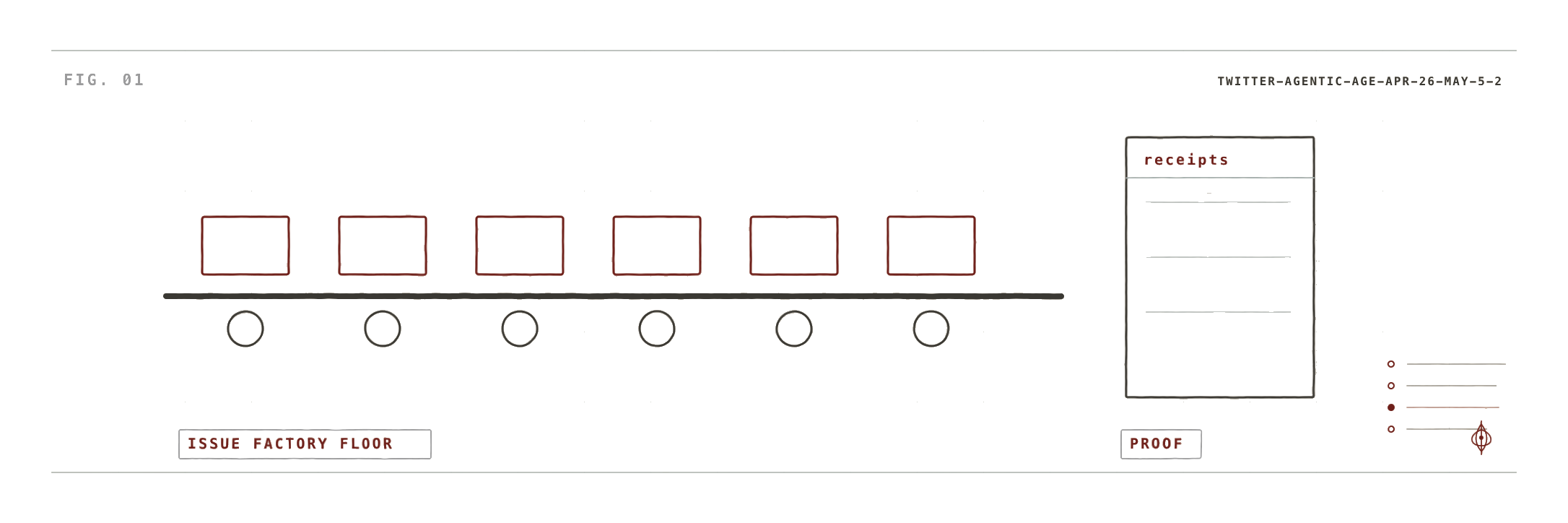
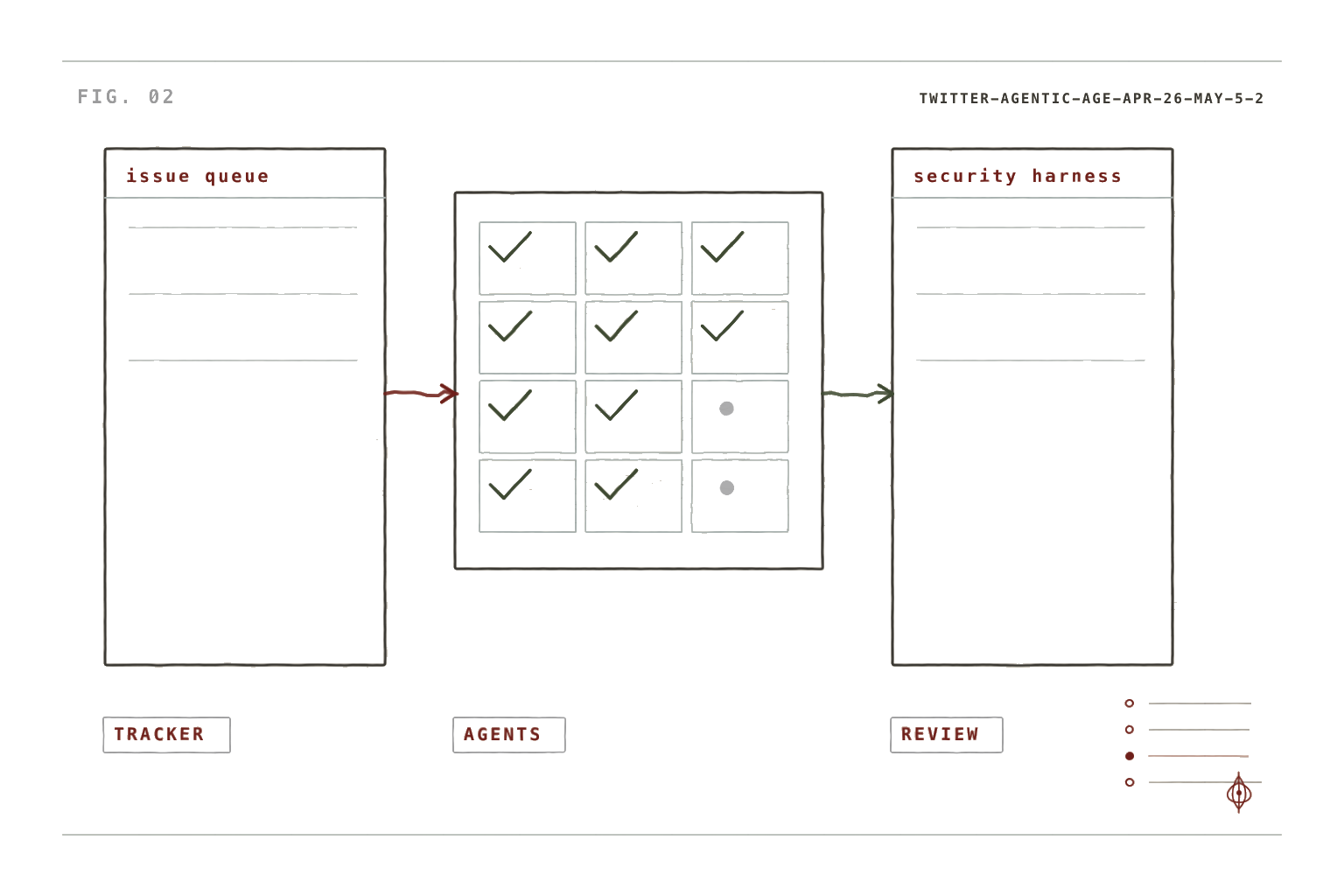
The final stretch was shorter, but it had a very specific smell: GitHub issues, PR queues, kanban boards, and background agents being asked to do janitorial work at industrial scale. OpenAI released Symphony, asking what would happen if every open issue had a Codex agent. Peter Steinberger built clawsweeper, running 50 Codex agents in parallel to triage and close thousands of issues. Nous added multi-agent Kanban to Hermes. Tibo called /goal perhaps the most consequential thing shipped in Codex. Vercel released deepsec, an agent-powered security harness.
If April 12-25 was platform week, this was operations week.
The funny part is that the operations are not glamorous. Closing stale issues, reviewing PRs, watching CI, scanning codebases, refreshing docs, maintaining boards, and generating receipts are exactly the kinds of tasks teams have been underfunding forever because they are tedious, political, and full of edge cases. Agents are being aimed there first not because it is easy, but because the pain is already structured.
There was also a strange new boundary crossed when Cloudflare announced agents could become Cloudflare customers: create accounts, buy subscriptions, register domains, and get API tokens. That sounds like a stunt until you realize it is the logical endpoint of the previous two months. If agents can plan, execute, test, deploy, and monitor, then eventually someone will ask them to sign up for the thing they need. The future, as usual, arrives first as an onboarding flow.
Key Movements
Work trackers became agent dispatch systems. Symphony, goal-maker, Hermes Kanban, and clawsweeper all treated issues and boards as the substrate for agentic work. This is a more important shift than it looks, because issue trackers already contain a rough map of responsibility, priority, failure, and unfinished intent. They are messy, but they are not blank.
Goal persistence became a core primitive. /goal and related clones made “keep going until this is achieved” a product-level concept rather than a prompt superstition. The difference matters. A persistent goal gives the system something to resume, inspect, and judge, instead of relying on the user’s memory of what the agent was supposed to be doing twelve tool calls ago.
Security harnesses emerged as necessary counterweight. deepsec and auto-review showed the review stack professionalizing around agent-produced code. The more agents write, the more security review has to become mechanized without becoming credulous. A scanner that merely produces more text is not enough; the harness has to create evidence a human can actually use.
Agents started entering commercial systems. Cloudflare letting agents become customers was the most literal version of “agents as actors.” It immediately raises boring questions, which are usually the real ones: who owns the account, whose card is charged, what scopes are granted, and how do you unwind the relationship when the agent got the domain name wrong.
The interface got quieter. Push notifications, ghui, RepoBar, and local browser agents all pointed toward less babysitting and more event-driven supervision. This is the right direction. If the agent needs constant attention, it is not really background work; it is foreground work wearing a trench coat.
Representative Signals
| Date | Actor | Why it mattered | Link |
|---|---|---|---|
| Apr 27 | OpenAI Developers | Symphony turned open issues into always-on Codex agent work. | View |
| Apr 28 | ClaudeDevs | Push notifications made walking away from long tasks a supported workflow. | View |
| Apr 29 | Cloudflare | Agents could become Cloudflare customers, which is ridiculous until it is not. | View |
| Apr 30 | Felipe Coury | /goal landed in Codex CLI as a Ralph-loop primitive. | View |
| May 3 | Tibo | /goal was framed as possibly Codex’s most consequential ship. | View |
| May 3 | Nous Research | Hermes Agent added multi-agent Kanban. | View |
| May 3 | Peter Steinberger | OpenClaw tooling used Codex to manage OSS issue and PR overload. | View |
| May 4 | Vercel Developers | deepsec open-sourced an agentic security harness. | View |
Engagement Ledger
| Tweet | Engagement |
|---|---|
| Rahul’s Claude Code feature walkthrough | 35.8K likes, 9.9M views |
| Claude developer conference announcement | 10.6K likes, 1.0M views |
2,000 DESIGN.md files | 10.5K likes, 1.5M views |
| Peter Steinberger’s clawsweeper | 9.4K likes, 2.1M views |
| Codex pets | 9.2K likes, 3.3M views |
| Warp open source | 7.8K likes, 2.8M views |
| Google Gemma local browser agent | 6.3K likes, 632K views |
| Nous Hermes multi-agent Kanban | 5.6K likes, 1.4M views |
| Cloudflare agents as customers | 5.3K likes, 1.6M views |
Tibo on /goal | 4.8K likes, 355K views |
Series Ledger
Across the full March 1-May 5 window, Anthropic and Claude dominated the visible product cadence: Code Review, auto mode, computer use, managed agents, routines, desktop redesign, Opus 4.7, Claude Design, Word, push notifications, Monitor, /ultraplan, /ultrareview, and the source leak that made everyone temporarily more interested in build artifacts than anyone had planned. The movement here was Claude as a work operating environment, not just a model.
OpenAI’s arc ran from GPT-5.4 computer use to subagents, Codex plugins, browser control, GPT-5.5, workspace agents, Symphony, Chronicle, auto-review, and /goal. Codex became increasingly explicit about persistence: agents that keep context, keep goals, keep working, and report back with receipts.
Google, Cloudflare, and Vercel supplied much of the operating layer. Google moved across models, design, skills, and enterprise governance. Cloudflare treated agents as first-class internet actors through crawl endpoints, Markdown content negotiation, browser rendering, Agents SDK work, and eventually agents as customers. Vercel pushed skills, plugins, AI Gateway, reference platforms, and deepsec, making the agent stack feel more deployable and less feral.
The broader pattern is that agents forced the software industry to rediscover all the boring parts of software: permissions, sandboxes, logs, issue trackers, design systems, review, memory, cost controls, scheduling, provenance, and user interfaces that make state visible without requiring the user to become a full-time air-traffic controller.
That is why the period feels both revolutionary and weirdly administrative. The frontier is not just better reasoning. It is making the work legible enough that a human can safely delegate without becoming either negligent or exhausted. The agentic age, at least in these bookmarks, is less “the machine writes the code” than “the machine joins the organization,” and the organization immediately has to invent onboarding, supervision, accounting, and HR for a coworker that can accidentally run Terraform.