
The British version of the Second World War has always landed oddly on me. The war killed aunts and grandmothers in my family. Rotterdam, my home town, had its centre bombed flat in 1940.
Britain remembers something different: the Blitz spirit, standing alone, Keep Calm mugs, home-front pubs, and politicians who can still summon “the spirit that got us through” whenever endurance would be more convenient than an honest account of the problem. The courage underneath that story was real. I do not doubt it for a moment. Yet the story built on top has become so clean, so flattering and so available for political reuse that I find my reaction to it a little bit repulsive, to be honest. The strength of that reaction surprised me enough to look more closely at why.
Britain’s war was genuinely different from the war on the continent. Great Britain was not occupied and had no collaborationist national government. The Blitz was devastating, but the country endured it and survived. A heroic national account could be told here with far fewer of the moral complications that an occupied society encounters once it begins examining its own compromises.
The Netherlands spent decades inflating its own resistance story. The resistance was real, but so was collaboration. Nearly eighty per cent of Dutch Jews were deported, the highest proportion in western Europe, and German authorities achieved that result with the co-operation of Dutch administrators and police. Survival could involve bravery, silence, complicity or choices for which there was no clean moral vocabulary. Our reckoning with that history has been slow and painful. I cannot criticise Britain’s comfortable war story while pretending the Dutch one was honest.
Britain’s edit still does a remarkable amount of work in the present. “We stood alone” was broadly true for one part of the war and radically incomplete as an account of victory. Britain drew on an empire containing a quarter of the world’s population. The Indian Army alone reached 2.5 million personnel and about 89,000 of them died. American finance and matériel were indispensable.
The familiar version also has little room for the Bengal famine of 1943. Historians dispute the relative weight of crop failure, inflation, local administration, imperial priorities and decisions in London, but not that wartime government policy contributed to a catastrophe that killed millions. That disagreement deserves more care than a morality tale in either direction permits.
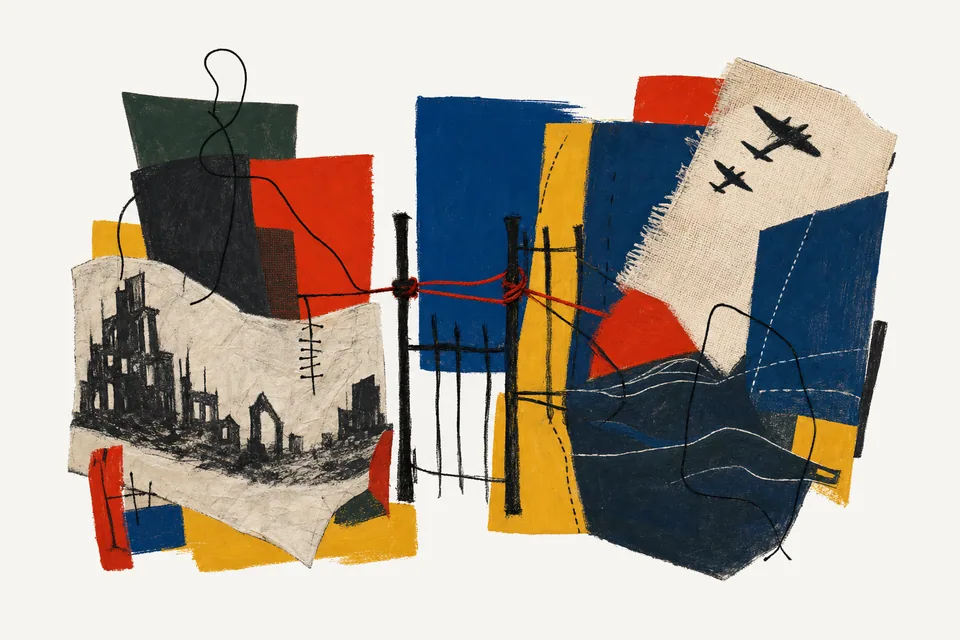
You can hear the wartime frame whenever endurance or independence needs a heroic precedent. I would not pretend that a war memory caused the Brexit referendum, but the promise to “take back control” drew emotional force from an older confidence that Britain is most itself when disentangled from Europe. During COVID the analogy became explicit: on 17 March 2020, Boris Johnson said the government had to act “like any wartime government”.
That version of the war makes independence feel like proof of national character. I have lived here for years and love living here; I still find that conclusion baffling.
Germany has Vergangenheitsbewältigung, a cultural framework for the difficult labour of confronting the past. The Dutch have been forced, slowly, to revise the consoling account of occupation and resistance. British scholarship has challenged the nationalist history built around 1940 too; David Edgerton traces how a broader imperial war was later nationalised into a British story, an account harder to summon with a phrase than “we stood alone”.
As a Dutchman criticising somebody else’s inflated war story, I come from a country that spent decades telling one of its own. British people really did meet terror with courage, and remembrance is not the same thing as chauvinism. I take issue with what the story is asked to justify after the wreaths have been put away, not with honouring the people who endured the war.
How aware are British people that this period still shapes the country’s idea of itself—in ceremonies, souvenir shops and the political choices that feel imaginable? I would genuinely like to know.
Source notes
- Rotterdam bombing chronology: Stadsarchief Rotterdam.
- Dutch deportation and administrative collaboration: NIOD and the United States Holocaust Memorial Museum.
- Empire and Indian participation in the war: Imperial War Museums on the British Empire and India in the Second World War.
- American Lend-Lease support for Britain: US Office of the Historian.
- Bengal famine scholarship: Colin R. Alexander, Oxford Academic and Janam Mukherjee, Hungry Bengal.
- Johnson’s 17 March 2020 statement: GOV.UK.
- British historiography of 1940: David Edgerton, “The Nationalisation of British History”.