
Clothes are one of those subjects in which inherited familiarity can pass for instinct. People who dress well may have watched what their parents wore, heard cloth and fit discussed, made inexpensive mistakes while growing, and absorbed hundreds of distinctions without ever calling the process study. My mother made sure art and museums were part of my upbringing. Clothes were not discussed with the same attention, so I decided to acquire that education deliberately.
I began in January 2025 with jeans and department-store shirts—decent ones, Zegna even—chosen mainly by size, label and broad colour. Sixteen months later I could spend a day distracted by the weight of my own sleeve, decide that a beige Clark oxford felt fractionally lighter than the other oxfords I owned, and turn out to be right.
Fun when that happens.
The Clark had spent about a year in storage. Its cloth was stiff, dense and plainly meant to be worn in; the comparison with workwear made sense as soon as I handled it. A fabric that tells you how it will age is now a source of pleasure. At the beginning I could barely have told cotton from merino without reading the label.
My first three merino dress shirts felt like polyester against my skin, and no account of merino’s virtues could make me enjoy wearing them. They were so unpleasant that I discarded them before thinking to return them. About forty per cent of what I bought in the first year was eventually donated or binned. Compressing an education normally acquired over many years was expensive and sometimes wasteful. I would return more now and discard less, but those comparisons taught me fabrics, weaves, mills, buttons, collars, proportions, tucked versus loose, and the remarkable distance between cloth that looks correct in a photograph and cloth I can bear to inhabit all day.
Oxford cloth was the first preference that became unmistakably mine. The basketweave breathes, holds some structure and gives my hand something to enjoy. When I lie down to read in the evening, my free hand often comes to rest on the shirt and stays there. The texture tickles my brain in a way I find intensely soothing.
The heavy American Pima oxfords I wear from October through March should feel like canvas. Instead, the long cotton staple makes all that substance unexpectedly soft, and my senses have to reconcile the weight with the hand each time I put one on. The lightweight oxfords are my favourites of everything I own. I have thirteen: Laurel, Sun, blue, light blue, wide light-blue stripe, light-blue stripe, blue stripe, Moss, Pink, Yellow stripe, Off White, Red stripe and Slate. Three blue stripes may look like weak inventory discipline. They do different jobs, and stripes provide the interest a tie might otherwise supply.
Caring about cloth creates new ways to be wounded by laundry. In April, three heavy oxfords came back with their sleeves shrunk by two or three inches: Atlantic blue, a blue stripe and the three-colour stripe on ecru. They looked as though I had borrowed them from a smaller brother. “Just look at what they did to my babies” was the only proportionate response. The service eventually reimbursed me after some insisting. The shirts remained ruined.
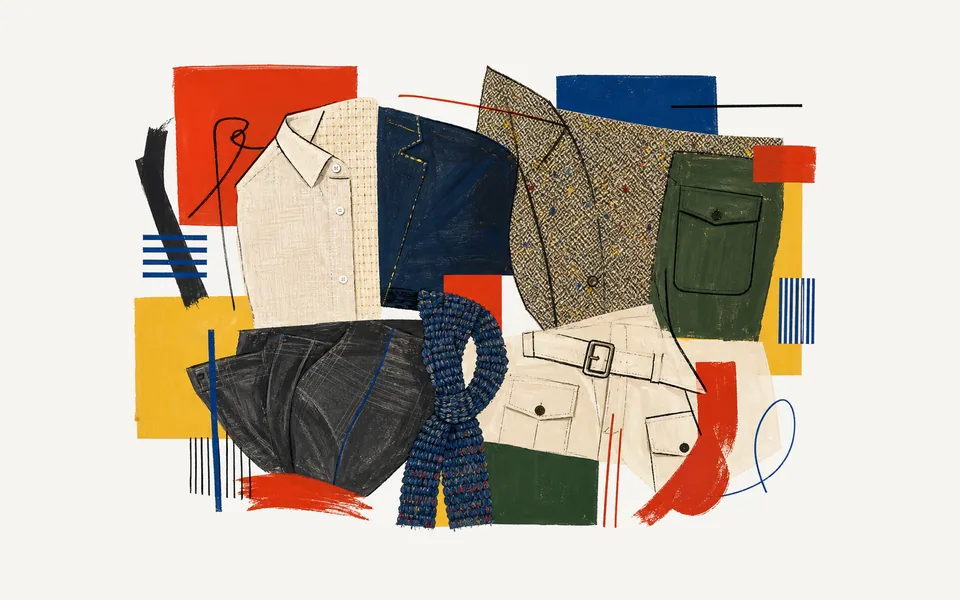
During that education I kept returning to Ivy. That was hardly preordained for someone raised in Rotterdam and shaped by Amsterdam, England, San Francisco and London, so I wanted to understand the attraction.
The appeal makes more sense as rebellion. I have never been drawn to capital-F Fashion, and prominent labels seem to cheapen personal expression: being Chanel is not the same as being me. Traditional English formality produces a stronger refusal—hard shoulders, strict uniforms, thin lapels and dusty rules pressing down on the wearer. Brogues? Hell no.
Ivy offered another way to make an effort. Its American and slightly academic character let me look put together without pretending to enjoy formal obedience, or making shock itself the identity as punk might. The figure I had in mind was an absorbed university professor or an artist in a studio: casual, soft, a little messy, wrinkled but never neglectful. Drake’s Games blazers, ISTO chore pieces and a Private White safari coat all let me wear something good without looking suited up.
By spring, my coat rack had become remarkably English and military-adjacent: two field jackets, a safari jacket and several chore coats. That concentration needed watching. I wanted the utility and drape, and every piece still had to justify itself on me. Some tailored blazers direct the eye straight towards my waist, while a chore coat with enough length and drape hangs well on me. The mirror settled the question.
I noticed the change most clearly in what I no longer wanted. An army-green jacket on sale did not tempt me because it leaned further into the military register than I liked, and I already had enough green. A solid light-blue shirt disappeared from the summer rotation because it came closest to the finance-bro office look; the striped blues survived. Moss, slate, gold, laurel, camel, olive, burgundy, ecru and rust all had clearer reasons to remain.
The rotation began with the best combination I had worn yet. I dressed by eye, looked in the mirror and thought, holy shit, this looks so good. I could see that it was right; I could not yet name the relations among colour, texture, weather and proportion that made it work. I wanted enough examples to compare them.
Fourteen outfits became twenty-one and then twenty-eight, with no shirt or trouser repeated within the week because the laundry goes out weekly. Laundry has more influence on personal style than most menswear writing admits. One row pairs a camel field blazer with a navy cotton-linen shirt and beige cords; another puts a jungle jacket over camel twill and grey chinos. After enough rows, the wardrobe stopped being a heap of individually attractive objects and became a set of working relationships.
I am aware of the comedy in using a twenty-eight-row plan to achieve something casual, soft and a little messy. The plan proved its value before work, when there were only so many minutes between coffee, mirror and door. It removed most of the mornings that followed me into the day feeling wrong. One rust shirt appeared so frequently that I became tired of seeing it and benched it for a week. It is back now, but no longer allowed to dominate the list.
Ivy is a rulebook, of course. Follow trad faithfully enough and a person can end up looking like an alumni photograph. I keep the rules that work with my body, work, climate and neighbourhood, and let the others remain in the book.
One preference has nothing to do with looks: I want the people who make my clothes to have enforceable wages and workplace protections. Buying from the UK or Europe once seemed a workable shorthand, until I learned that a country of origin may identify only the last substantial stage of manufacture and a European label says very little about the conditions in every factory behind it.
The contradiction is hanging in my wardrobe. Proper Cloth is an American company with factories in Vietnam, and I have not found another maker with the same service, selection and quality at a price I can justify. I keep buying the shirts while wishing I knew much more about the people who make them. I have not found a neat way around that.
In May I went into the Drake’s shop and tried a black chore jacket in heavy cotton twill. They had my size in four colours. The black one was plain, soft and slightly brushed in the hand, and it fit without compromise. After sixteen months of ordering, returning, donating, comparing and learning, I no longer needed a long search or a second opinion. I put it on, knew and paid.
The Clark is still stiff and will need many washes before it softens. It feels super hardy. I’m not worried about it.