
As a Sea Scout I sometimes slept in a small sailing boat on open water. Rotterdam never showed me a sky like the one above that boat: countless stars, the dark carrying on beyond them, and nothing for company except the sound of water lapping against the wale. It was cold, wet and far from everything familiar. I loved it. It may have been the best feeling in the universe.
I had joined the Boy Scouts at eight and moved on to Sea Scouts, staying until I was sixteen. Those years were full of flashlights among dark trees, hunting clues with compass and map; calm rivers and wild large lakes; watchtowers built from trunks and rope; rafts made with not much more; knots, sails, tents, mud and the particular pleasure of being capable outdoors. We had to read weather and water, work with what was around us and make ourselves useful in it.
A search for loafers brought those years back this spring. I had worn Allbirds almost exclusively for a year or two. When the Guardian reported in April that the company planned to leave shoes for AI infrastructure, I began to suspect I would need a new favourite. Loafers had the Ivy, absorbed-professor air I liked, and I wanted to know whether one could also have enough substance for uneven pavement, grass and gravel. My notes called the search “a flirtation, not a decision yet.”
The brochures became funnier as my frame of reference widened. Shops call the Paraboot Thiers light, casual and easy. That is reasonable among welted leather shoes, where a few hundred grams makes a perceptible difference. Beside a knitted trainer, the Thiers is enormous. One description called it “a substantial shoe that happens to open at the top.” Buddy, they all open at the top. That is where our legs attach to our feet.
Two weeks into the flirtation I tried a black Paraboot Reims and felt the puzzle piece click. It was a lot of shoe: heavy sole, abundant attitude, character without delicacy. The Reims is an iffy loafer and an excellent stomper, perfectly willing to cross gravel and grass while remaining handsome menswear. An Astorflex loafer supplied the useful alternative. It was comfortable, but its register was V8, diner, hamburgers. Not what I am.
The speed of that attraction made me curious. I could point to deserts in Nevada and New Mexico, rivers in Austria, Dutch mud and the country roads in Britain I look at with longing, but the preference was older than those journeys. It belonged to the boy in a scouting blouse, dressed in what were essentially chinos, button-up shirts and solid shoes. The neck scarf went on when we presented ourselves and came off when hard work began. Everything had to survive water, rope, dirt and a week at camp.
I have never sailed upwind, trimming my own sail and calling instructions to other scouts, while worrying that a thin suit fabric might tear. I have never lain in a tent wishing for a precious dress overcoat. This is not a fantasy about becoming a hardy country boy, nor an attraction to military costume, though scouting shares some ancestry with both. It is a sensory expectation formed early: clothes should let me participate in the world without fretting over them.
The oxford button-downs I love belong to the same history. Six years in the United States gave me their academic association, which I enjoy, but the cloth also feels like the scouting blouse: stronger, practical, textured enough to show work rather than fear it. Field jackets, chore coats and soft Games blazers have one foot in that life too.
I was suspicious of the insight because it arrived during a consumer decision. A formative memory is a dangerously convenient justification for buying the nicer shoe. Yet I had felt the scouting connection in my shirts before the Paraboot search and failed to follow it. The shoes merely pulled the loose thread far enough for the pattern to appear.
Going through those memories moved me to tears. I had been treating my attraction to solid cloth and shoes as a recently acquired taste, then recognised a much older continuity. Scouting had taught me the pleasure of competence, practical beauty and taking part in the world without fussing over what I wore. Ivy later supplied vocabulary for a preference that was already mine.
Then I had to get the fit right. Another Paraboot had joined the shortlist by then: the Michael, a thick-soled model introduced in 1945. It is blunt and a little ugly, both qualities I find appealing.
At the fitting, I learned that I am an 8.5, a full size smaller than the sneakers I had been wearing. An earlier fitter had merely asked whether a pair felt right. That question is useless when nobody has shown you what a good fit feels like.
I rebought the Reims in the correct size and fitted the Michael with an insole that had a proper heel cup. I walked around the flat first, then took them onto the uneven pavements around Elephant & Castle. Over the next two weeks I learned the difference in stride: their weight and stiffer soles called on muscles my trainers mostly ignored. Leather shoes changed the work of walking much more than I expected.
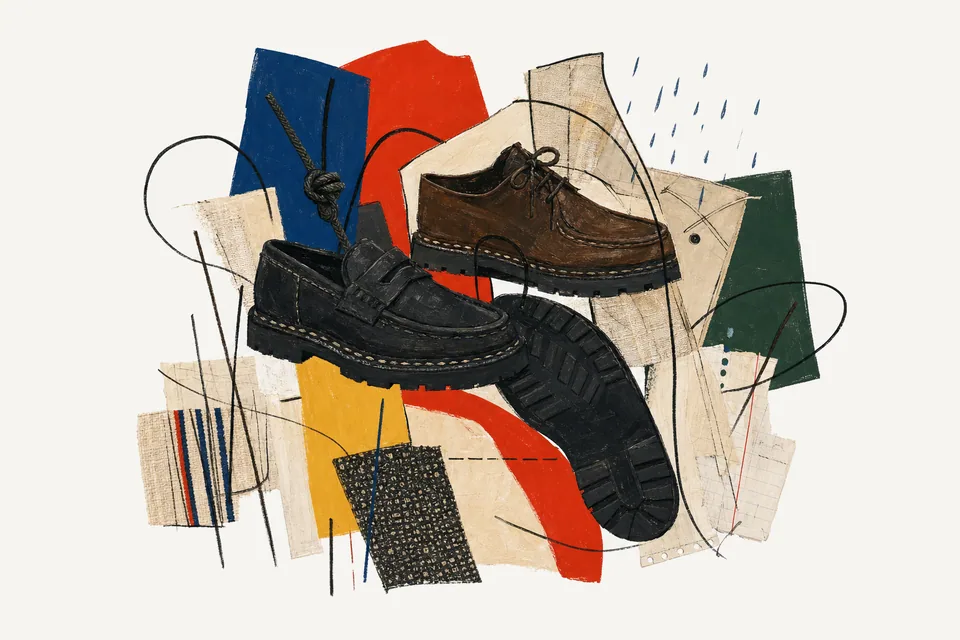
There are now three pairs by the door: Reims in café and noir, and a Michael Cerf in marron. I hope the Reims keep pulling that earlier world into view when I put them on—the boat, the cold, the stars and the water against the wale.